)
From Lab Bench to Field: 30+ AgTech Start-Ups Set to Tackle Farming's Biggest Bottlenecks at World Agri-Tech London 2026
Chemical-free crop protection, affordable robotics and real-time soil intelligence headline a start-up cohort moving from lab-stage science to field validation.
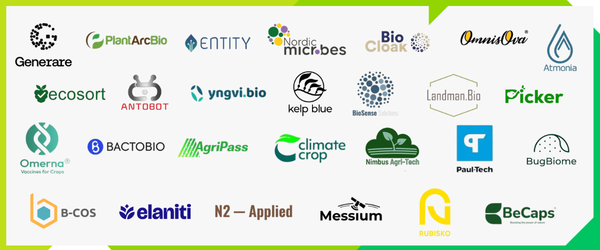
LONDON, UK - Chemical resistance is rising. Input costs continue to climb. And every link in the food supply chain increasingly wants proof of where a product came from. On September 22-23, 2026, more than 30 start-ups will step onto the floor of the World Agri-Tech Innovation Summit at the InterContinental London - The O2, each built to answer a piece of that pressure - with biologicals and robotics moving from early research into field validation or commercial deployment.
Across pitching sessions, curated showcases, breakout discussions and the exhibition floor, this year's founders will connect directly with the agribusiness, food, investment and farming leaders who can turn a promising pilot into a scaled deployment.
Reducing Chemical Dependency Without Compromising the Crop
Resistance is building against conventional pesticides and fungicides just as regulators tighten the rules around them - and a cluster of London's start-ups is attacking that problem from multiple scientific angles.
Bactobio (UK) combines AI, genomics and bioengineering to unlock previously unculturable microbes and mine them for novel fungicides with new modes of action. Nordic Microbes (Denmark) is bringing commercial microbial biosolutions - including an upcoming biofungicide - to market as alternatives for crop protection and soil health. Yngvi Bio (Denmark) is developing an AI-powered modular platform that combines pest-specific delivery with tailored protein biocides. B-COS (Belgium) uses defined chitooligosaccharides to activate crops' natural immune defences against fungal diseases and nematodes. BugBiome (UK) uses insects as a discovery engine for new biological actives, while Landman.Bio (Belgium) develops targeted bacteriophage solutions against bacterial pathogens in agriculture and animal health.
Robotics Built for the Farms That Already Exist
Precision agriculture has long been positioned as a large-farm luxury. Two UK start-ups are working to make it more practical and accessible.
Antobot (UK) develops embodied AI and intelligent robotics for sustainable agriculture, with integrated hardware and software enabling perception, decision-making, mobility and autonomous operation. Its robots are being deployed for UV-C treatment, logistics and crop scouting. Nimbus Agri-Tech (UK) is developing compact, fully electric robots that offer vineyards, orchards, hop gardens, soft-fruit growers and tree nurseries a mechanical alternative to herbicides without the usual labour penalty.
Smarter Inputs and Living Soil
Getting more out of every acre starts underground - and, in one case, in the ocean.
Atmonia (Iceland) is rethinking nitrogen fertiliser through a distributed, modular production system. Its single-step electrochemical process produces green ammonia from air, water and electricity at ambient conditions. Kelp Blue (Netherlands) cultivates offshore seaweed forests and processes harvested canopy into liquid biostimulants designed to support crop resilience and yield, while supporting marine biodiversity and carbon storage. Paul-Tech (Estonia) provides real-time, solar-powered soil monitoring by combining in-field moisture, temperature and nitrate measurements with weather modelling and satellite imagery. Elaniti (UK) uses AI to model soil as a living, biologically rooted system, helping agricultural teams de-risk decisions and accelerate R&D.
Proving Where Food Comes From
As traceability shifts from nice-to-have to non-negotiable, three companies are building the infrastructure to prove it.
Ecosort (Norway) delivers on-farm fruit and berry quality control through non-invasive scanning and machine learning. Entity (Italy) turns field and logistics events into verified, actionable data through IoT and software, improving traceability, operational visibility and reporting. RUBISKO (UK) builds affordable software and data systems for emerging bio-based industries, supporting traceability, compliance, operations and predictive insight.
Genomics and the Next Frontier
A trio of start-ups is pushing agtech's platform science into new territory. OmnisOva (Australia) applies next-generation genomics to the bird and egg, exploring applications across food, medicine and manufacturing. BioCloak (US) engineers bio-based particles and biodegradable delivery systems that enhance stability, performance and targeted release in animal nutrition and crop protection formulations. BioSense Solutions (Denmark) develops high-throughput imaging for rapid fungal spore counting and germination analysis, accelerating the development of preservatives, antifungals and biopesticides.
An Innovation Pipeline Six Partners Deep
This year's cohort is amplified by six Innovation Partners, each bringing a curated network, specialist expertise or investment insight to the summit:
- Cultivator accelerates pre-seed and seed-stage Canadian and UK agtech founders through product-market-fit work, weekly one-to-one mentoring, investor introductions and access to agriculture leaders. Across four cohorts, 62 companies have raised $210 million, generated $170 million in revenue and created 335 jobs.
- EIT Food connects entrepreneurs, researchers, businesses and investors across Europe to accelerate innovation and build a healthier, more sustainable food system.
- IFA Innovation Hub returns with the Cultivate Challenge, connecting corporates, investors and entrepreneurs around technologies that improve efficiency and resilience across plant nutrition. Its confirmed summit portfolio currently includes BeCaps, Messium and N2 Applied.
- Lapwing Group joins as an Innovation Partner with a focus on farm-first innovation. Further programme and cohort information will be announced.
- The Yield Lab Europe brings the perspective of an early-stage agtech impact investor supporting businesses that improve the sustainability, efficiency and profitability of food and agriculture.
- UK Agri-Tech Centre provides end-to-end support for agtech development and adoption through facilities, technical expertise and business support, strengthening connections between science, businesses and funders.
Why It Matters
Taken together, this year's cohort tells a bigger story than any single pitch: biologicals, robotics, intelligent inputs and traceability tools are progressing from lab-stage promise toward field validation and commercial deployment. For an industry facing resistance, cost and proof-of-origin demands at the same time, that shift - happening in real time at World Agri-Tech London - is the progress growers, investors and agribusiness leaders need to see.
World Agri-Tech Innovation Summit London takes place September 22-23, 2026, at the InterContinental London - The O2.
Explore the featured start-ups: www.worldagritechinnovation.com/start-ups
View the agenda and book tickets: www.worldagritechinnovation.com/agenda
)
)
)
)
)
)
)
)
)
)
)
)
)
)
)
)